

CME Group to Sue CFTC Over Approval of Perpetual Futures
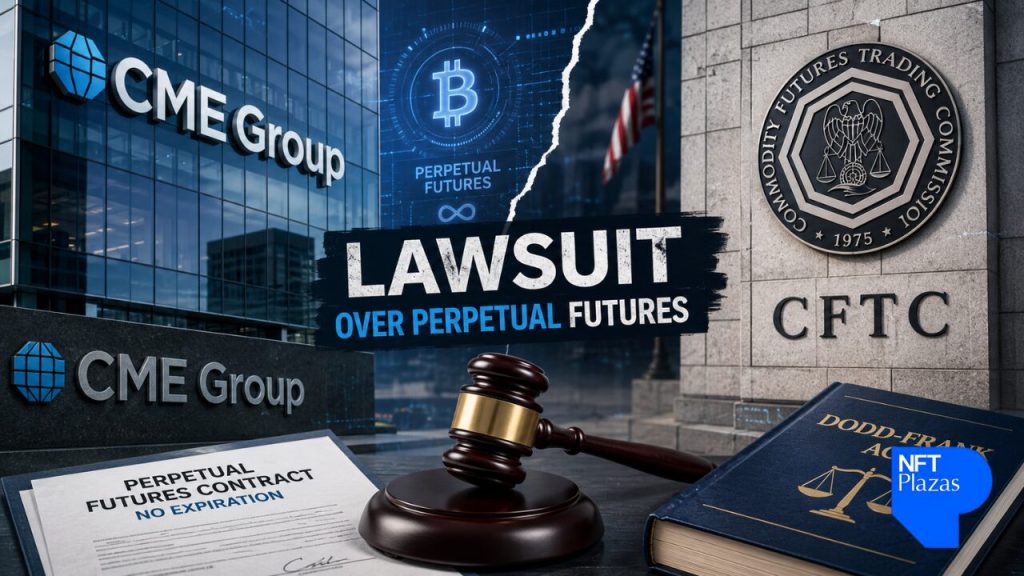
The world’s largest futures exchange operator has escalated its battle against crypto derivatives deregulation, announcing plans to take the U.S. government to court over a product it says never should have been approved.
CME Files Lawsuit Against the CFTC
CME Group, the world’s largest futures exchange operator, is planning to sue the Commodity Futures Trading Commission over the agency’s decision to approve perpetual futures contracts. CME Chief Executive Terrence Duffy confirmed the move in a CNBC interview on Wednesday, saying the derivatives provider plans to file the lawsuit on Thursday after the CFTC approved perpetual futures products earlier this month.
Duffy asserted that perpetual futures are actually swaps under the Dodd-Frank Act, and that this will form the basis of CME’s lawsuit. Under Dodd-Frank, Duffy argued, the law clearly defines what a swap is and what a future is — and when two parties are exchanging payments with each other, that is legally deemed a swap. The distinction is more than semantic. Classifying perpetual contracts as swaps rather than futures would fundamentally reshape how they are regulated, who can offer them, and what compliance obligations apply.


CME Files Lawsuit Against the CFTC
What Triggered the Lawsuit
The CFTC approved prediction market platform Kalshi in late May to begin offering bitcoin perpetual futures — marking the first time the asset class, already popular overseas, was allowed in the U.S. Kalshi has since expanded its perps offerings to include other cryptocurrencies. Coinbase also received the CFTC’s approval to offer perpetual crypto futures, with shares of CME Group, Cboe Global Markets, and Intercontinental Exchange all declining after the CFTC’s approvals were announced, as investors assessed the competitive threat perpetual futures could pose to established exchange operators.
Duffy also argued that CME’s existing licensing arrangements further complicate the picture: “We have an exclusive license with every single provider of the benchmarks. So all of these would have to go through CME regardless of the perpetual.” He added that if regulators determine the products can be listed, they should be categorized as swaps rather than futures.
Process Concerns and Systemic Risk Warnings
Beyond the legal classification argument, Duffy raised concerns about how quickly the CFTC moved and the leverage exposure the products introduce for retail investors. Duffy criticized the CFTC’s approval at the Piper Sandler Global Exchange & Fintech Conference earlier this month: “I have grave concerns with the way these contracts are set up. I don’t like to see people that don’t understand products to potentially get blown out of a contract that they shouldn’t be in the first place.” He added that the CFTC’s review of perpetual futures wrapped up faster than a typical self-certification window, especially for such a novel instrument.
Perps can carry leverage as high as 50-to-1, meaning small price moves can wipe out a trader’s margin and trigger automatic liquidations. Ongoing funding payments — the mechanism that keeps perpetual contracts anchored to spot prices — can also quietly erode returns over time.
Duffy drew a broader parallel to pre-2008 financial conditions: “The housing market has been supplanted by the speculation market, including predictions and everything else, and this could be a disaster waiting to happen.”
Eight Months in the Making
Duffy disclosed that CME has been working with its board on the legal challenge for approximately eight months, signaling the exchange is prepared for a prolonged fight. “We will be filing this litigation tomorrow because we are not taking this lightly,” he said. He also went further when asked whether the CFTC had been misrepresenting certain facts, saying he believed it had “to an extent,” pointing to the agency’s release on 24/7 trading — which the CFTC described as a rule when, according to Duffy, it was not one.
CFTC Pushes Back — and Denies Political Influence
Duffy’s remarks came just days after CFTC Chairman Michael Selig defended the agency’s decision to permit perpetual futures products in the U.S., stating: “It’s time to approve regulated futures contracts that have no expiration date. We’re going to make sure the product’s available, but it’s well regulated here in the U.S.” Selig also firmly denied that the approval was influenced by political pressure from the Trump administration, asserting that such insinuations were baseless and highlighting the independence of the agency’s regulatory decisions.
What’s at Stake
Behind the legal fight is a competitive one. If U.S. venues can list no-expiry contracts, some trading could migrate away from traditional expiring futures and into perps, allowing the listing exchange to capture stickier open interest and the trading and clearing fees attached to that activity. CME’s lawsuit adds a near-term question mark over how quickly Coinbase and Kalshi can scale their offerings, and whether the CFTC is forced to slow down or revisit parts of its approval.
If CME succeeds, regulators may be forced to reconsider whether perpetual contracts fall under futures regulations or should instead be treated as swaps under Dodd-Frank — a decision that could significantly alter compliance requirements, market access, and the competitive landscape for firms seeking to offer perpetual crypto products.
The lawsuit disclosure also came on the same day CME announced that Duffy will step down next year after approximately a decade as chief executive, to be succeeded by company insider Lynne Fitzpatrick — who will become CME’s first female CEO. Duffy said CME would “need to understand what the rules of the road are first” before considering listing perpetual futures of its own, but acknowledged those rules are not “very clear” at present.